
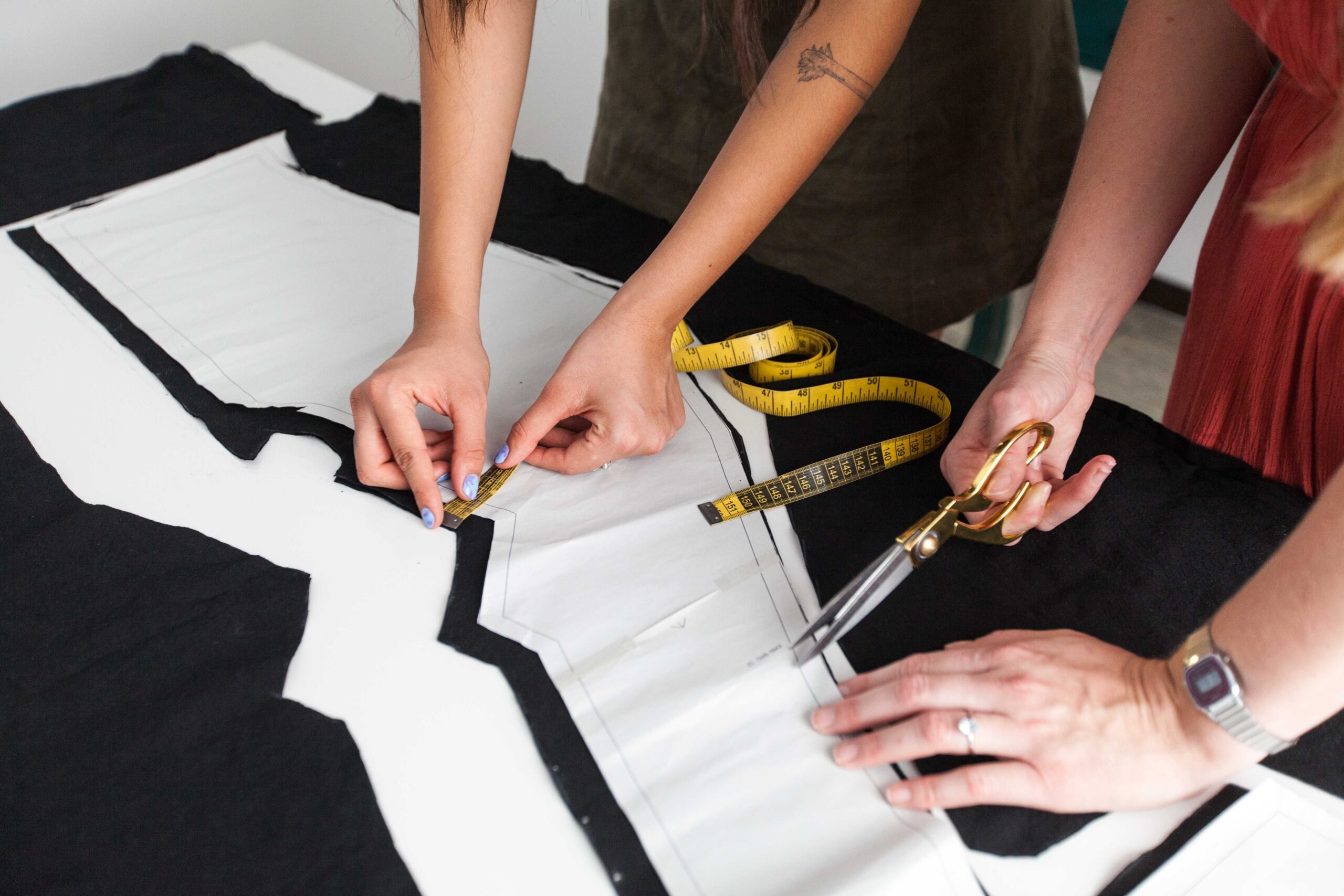

How Two-Dimensional Geometry Becomes a Three-Dimensional, Moving, Manufacturable Garment
A professional field guide to body geometry, fit, material behaviour, pattern construction, grading, industrialisation, digital fitting, quality, cost, and the intelligence hidden inside every cut line.
A Millimetre, a Thousand Garments
A pattern cutter moves one point on an armhole by four millimetres.
On paper, almost nothing has happened. The line still looks like an armhole. The sleeve still appears to fit it. The silhouette is unchanged to the untrained eye.
But the line is not merely a line. It defines part of an interface between body, cloth and motion. Its length influences the sleeve-cap relationship. Its curvature changes where fullness is distributed. Its position affects shoulder mobility, balance, hang and the direction of wrinkles. When the alteration is graded across ten sizes, nested into markers, cut through dozens of plies and repeated in several factories, four millimetres become tens of thousands of physical consequences.
If the decision was correct, the garment lifts cleanly with the arm, hangs quietly at rest and survives production without special handling. If it was wrong, the sleeve may twist, the front may drag backward, the operator may stretch one seam to make the notches meet, the pressing team may attempt to disguise the distortion, quality control may widen tolerances, and customers may describe the result with the most commercially expensive sentence in fashion: it just does not fit right.
This is why pattern cutting is the engineering behind fashion.
Fashion design proposes an experience. Pattern cutting converts that proposal into geometry. Garment engineering turns the geometry into a repeatable product under the realities of fabric, machinery, labour, time, size variation, care, movement and cost. The three disciplines overlap, but they do not perform the same work.
A beautiful sketch can ignore gravity. A pattern cannot. A sketch can suggest a shoulder without deciding its pitch, a waist without defining suppression, a sleeve without reconciling two seam lengths, or a drape without confronting grain. The pattern must decide. It is the first place where intention becomes accountable.
The pattern is also more than a template used to cut cloth. In an industrial system, it is a compact technical model containing shape, dimensions, balance, ease, seam architecture, assembly references, material direction, size logic and production instructions. It is simultaneously:
- A geometric translation of the body and the design.
- A behavioural hypothesis about the chosen material.
- An interface specification for pieces that must assemble correctly.
- A manufacturing instruction for cutting and sewing.
- A cost driver because its perimeter, area and layout affect labour and fabric yield.
- A quality standard against which samples and production are judged.
- A digital asset that may be graded, simulated, exchanged, versioned and reused.
- A repository of tacit knowledge about what the brand believes “fit” should feel like.
That final point is crucial. Two garments with the same chest measurement can fit differently because fit is not a number. It is a controlled relationship among body shape, garment shape, ease distribution, fabric mechanics, posture, construction, styling and expectation. Pattern engineering governs that relationship.
This field guide follows the entire chain: from the human body to the basic block; from dart manipulation to sleeve balance; from fabric tests to seam allowances; from sample fittings to grading; from marker efficiency to automated cutting; from 3D avatars to artificial intelligence; and from technical quality to commercial value. It is written for designers, pattern cutters, technical designers, product developers, production engineers, factory leaders, founders, investors and students who want to see the garment not as a mysterious object, but as an engineered system.
A pattern is fashion’s executable specification: it tells material where to exist, how pieces must meet, and what shape should emerge when the instructions encounter a real body.
Part I: Learning to See the Garment as an Engineered System
1. The Translation Stack: From Desire to Repeatable Product
Every garment passes through a translation stack, whether the company recognises it or not.
Design intent defines the visual, emotional and functional proposition. It may specify authority, ease, seduction, protection, speed, softness, ceremony or rebellion.
Body definition identifies the intended wearer: dimensions, proportions, posture, morphology, movement, underlayers and fit expectations.
Material definition describes the medium: structure, grain, stretch, recovery, drape, weight, thickness, friction, shrinkage, skew, surface and response to pressing.
Pattern geometry converts the first three layers into two-dimensional shapes, internal construction lines and relationships among pieces.
Assembly engineering determines how cut components become a stable product: seam and stitch classes, allowances, order of operations, reinforcement, shaping, pressing and tolerances.
Production system repeats the product across sizes, colours, lots, operators, machines and factories.
Use system begins when the wearer moves, sits, washes, stores, repairs and eventually resells, remakes or discards the garment.
The pattern sits at the centre. It receives assumptions from upstream and sends consequences downstream. If body data are wrong, the pattern encodes the wrong wearer. If the actual fabric differs from the tested fabric, the geometry behaves differently. If a construction method changes without compensating the pattern, finished measurements move. If grading rules preserve circumference but distort balance, only the base size will appear correct.
This makes pattern cutting a form of systems engineering. The professional does not optimise an isolated line; they manage interfaces.
| Layer | Engineering question | Failure when the answer is weak |
| Design intent | What must the garment look, feel and allow? | A technically correct garment that misses the idea |
| Body definition | Which bodies, postures and movements must it serve? | A sample that fits the model but not the market |
| Material definition | How will the substrate stretch, drape, shrink and recover? | Geometry that changes when made in production fabric |
| Pattern geometry | What flat shapes will create the required volume and balance? | Drag lines, twist, restriction, collapse or excess |
| Assembly engineering | How will edges be joined and stabilised? | Mismatched seams, distortion, bulk or weak construction |
| Production system | Can the result repeat within controlled variation? | Sample-room success and factory-floor failure |
| Use system | What happens in motion, care, wear and repair? | A garment that passes inspection but fails the customer |
2. Pattern Cutter, Pattern Maker, Technical Designer and Garment Engineer
Industry titles vary by country, company and tradition. In the United Kingdom, pattern cutter is common; in the United States, patternmaker is widely used. Couture houses, tailoring workshops, sportswear companies and mass manufacturers divide responsibility differently. The important distinction is the work, not the title.
A creative pattern cutter often collaborates closely with the designer to discover silhouette through flat cutting, draping or experimental methods. Their work can be interpretive and authorship-heavy.
A production patternmaker converts an approved design into complete, manufacturable pattern pieces with correct seam allowances, notches, balance marks, internal lines and construction references.
A technical designer commonly controls fit comments, measurement specifications, construction details, tolerances, sample approvals and communication between brand and factory.
A garment technologist or garment engineer connects material performance, construction, machinery, quality, compliance, costing and scalable production.
A grader develops the size range by applying controlled dimensional and shape changes to the base pattern.
A marker planner arranges pattern pieces for cutting efficiency under grain, nap, matching, size-ratio and production constraints.
In a small atelier, one expert may perform all six roles. In a global organisation, they may sit on different continents and exchange digital files through product lifecycle management systems. Both structures can work. Failure occurs when responsibilities are separated but the interfaces are not owned.
The most dangerous gap is between creative pattern and production pattern. A runway sample may contain hand-tuned asymmetry, generous seam allowances, undocumented stretching, temporary support or specialist pressing. If those hidden operations are not converted into explicit production logic, the factory is asked to reproduce an outcome without its causes.
3. The Pattern Is a Model, Not the Garment
Engineering models simplify reality so that decisions can be made. Patterns do the same.
A pattern generally assumes a reference body, a posture, a material state, a method of assembly and a level of symmetry. It does not contain the entire body. It contains the geometry judged necessary to produce a useful garment around that body.
This distinction protects professionals from false precision. A computer can report a curve length to hundredths of a millimetre, but the physical result will still be affected by fabric relaxation, ply compression, cutting accuracy, seam formation, operator handling, pressing and measurement method. Digital precision is valuable only when paired with a realistic error model.
The pattern therefore functions as a nominal definition. Production creates a distribution around that nominal value. Specifications and tolerances define how much variation remains acceptable.
Finished measurement = pattern measurement − seam take-up + construction effects + material-state effects
The signs can change. A bound edge may add bulk. A fused panel may shrink. An elasticated seam may contract. A bias edge may grow during handling. Pressing may shape one region and flatten another. The equation is not a universal calculator; it is a reminder that a pattern dimension is not automatically a finished-garment dimension.
4. The Vocabulary of Pattern Engineering
A shared vocabulary prevents teams from using one word for different artefacts.
A block is a foundational pattern representing a body-and-ease relationship for a garment category. A bodice block, trouser block, sleeve block and knit block encode different assumptions.
A sloper is often used, especially in American practice, for a close-fitting foundational pattern with minimal design detail. Some organisations use block and sloper interchangeably; others reserve block for a proven company standard.
A master pattern is a controlled source from which related styles or production patterns are developed.
A working pattern contains construction and style development before final industrial clean-up.
A net pattern is commonly understood as the shape at the stitching or finished line before seam allowances are added.
A production pattern contains the full cut shape and manufacturing information required for repeatable production.
A toile or muslin is a prototype made to test shape, balance, proportion and construction, usually in an inexpensive substitute fabric. A toile is not automatically predictive if its properties differ materially from the intended cloth.
A counter-sample, fit sample, size-set sample, pre-production sample and sealing sample answer different questions. Treating every sample as a generic “prototype” creates approval confusion.
Net line and cut line
The sewing line expresses intended assembled geometry. The cut line includes seam and hem allowance. Good digital systems preserve the relationship between them. This matters because changing an allowance should not silently change finished shape, and changing finished shape should propagate correctly to related edges, corners, notches and internal features.
5. Five Coordinate Systems Operate at Once
Pattern cutters work across several coordinate systems, often without naming them.
The body system uses anatomical landmarks, circumferences, arcs, verticals and surface distances.
The garment system uses centres, side seams, balance points, style lines and finished levels.
The fabric system uses warp, weft, wale, course, bias, nap, print repeat and stretch direction.
The pattern system uses points, curves, straight lines, grainlines, drill holes, notches and seam relationships.
The machine system uses needle position, folders, guides, seam width, feed, turn radii and operator handling.
A correct decision in one system can be wrong in another. Rotating a piece may improve marker yield but violate nap direction. Moving a seam may flatter the body but create an impossible turn through an automated folder. Straightening a curve may simplify sewing but remove required volume. Adding ease at the side seam may increase circumference but fail to put space where the body needs it.
Expert pattern engineering is largely the art of keeping all five systems coherent.
Part II : The Human Body Is the First Geometry
6. Anthropometry: Measuring People Without Reducing Them to Numbers
Anthropometry supplies dimensional evidence for design. It does not tell the designer what fit should be.
ISO 8559-1 describes anthropometric measurements and their anatomical bases for clothing product development, population profiling and fit-mannequin creation.[1] ISO 8559-2:2025 makes an equally important distinction: clothing size designation is based on body measurements, while garment measurements remain a design and manufacturing decision that incorporates ease, style and intended wear.[2]
This separates three quantities that inexperienced teams often confuse:
- Body measurement: the dimension of the person under a defined protocol.
- Garment measurement: the dimension of the finished product under a defined measurement method.
- Pattern measurement: the geometric dimension on the pattern before all construction and material effects.
The difference between body and garment measurement is often called ease, but even that requires care. The same total ease distributed differently produces a different fit.
Measurement is a protocol
A measurement without method is ambiguous. “Waist” might mean the natural waist, the preferred trouser waist, the garment waistband seam or the narrowest torso point. “Back length” changes with landmark, posture and path. A tape can be held horizontally, follow the surface, bridge a hollow or compress soft tissue.
A defensible protocol specifies:
- The anatomical landmarks.
- The subject’s posture and breathing state.
- The garment or undergarment condition.
- Whether the measurement is linear, arc, circumference or surface distance.
- Tape tension and orientation.
- Side, if asymmetry matters.
- Instrument and rounding rule.
- Operator training and repeatability checks.
The objective is not to make every human body conform to a standard. It is to make observations comparable.
7. Bodies Have Shape, Posture and Distribution: not Only Circumference
Two people can share bust, waist and hip circumferences while requiring different patterns.
One may carry more volume toward the front abdomen; another toward the back hip. One may have a rounded upper back, forward shoulder and prominent shoulder blades; another an erect posture and flatter back. One bust may project forward with a narrow root; another may distribute volume broadly. The numbers match, but surface geography does not.
This is why a sizing system based only on girth increments is incomplete. ISO 8559-3 describes the statistical development of body-measurement tables and intervals, while ISO 8559-4 addresses coverage ratios for target populations.[3][4] Coverage is not merely “how many people fall between two bust measurements.” It depends on the joint distribution of selected dimensions and, in advanced systems, shape.
Recent research using 3D scans continues to show the commercial value of morphology. A 2025 study of lower limbs developed 12 shape clusters and eight sizes within each shape for compression-garment customisation, illustrating how one linear size axis can conceal important contour differences.[5]
Posture is part of fit
Posture changes the relative lengths and projections the garment must accommodate. A forward shoulder can make a theoretically balanced sleeve rotate backward. A prominent seat needs length as well as circumference. A seated body changes hip, thigh, abdomen, knee and back relationships. Research using standing and sitting 3D dress forms demonstrates that posture changes both body measurements and three-dimensional shape relevant to pattern design and fit evaluation.[6]
The professional question is not “Is this body normal?” It is “Which posture and shape did the pattern assume, and how far is this wearer from that assumption?”
8. Static Body, Dynamic Body and the Envelope of Motion
Clothing is fitted in poses but worn through movement.
The static body supplies a starting surface. The dynamic body creates an envelope: skin stretches, landmarks move, joint angles close, muscles expand, soft tissue redistributes and body segments collide. A fitted jacket that is perfect with arms resting may fail when the wearer drives. A trouser that looks clean while standing may bind when seated. Protective, performance and adaptive garments make these failures more consequential.
Movement accommodation can come from several sources:
- Positive ease.
- Material stretch and recovery.
- Pleats, gussets, action backs and articulated panels.
- Bias orientation.
- Strategic seam placement.
- Elastic, rib or expandable components.
- A silhouette that allows the body to move inside it.
The system must also recover after movement. A fabric can stretch enough to permit a squat yet fail to return, leaving bagged knees. A shoulder pleat can provide reach but disturb the desired back appearance. Engineering asks both whether movement is possible and what the garment looks like afterward.
9. The Target Body Is a Strategic Choice
There is no universal base body.
A company chooses a target market, consciously or accidentally. The base size, fit model, dress form, scan dataset and block library encode age, geography, gender convention, morphology, posture and brand position. If those assets do not represent actual customers, the organisation may spend years “fixing” styles while preserving the wrong foundation.
ASTM D5585-21 provides body-measurement tables for an adult female misses figure type and explicitly positions them as a baseline to be considered alongside fabric, movement, style and fit.[7] That wording matters. A standard table is evidence, not destiny.
A strong target-body strategy answers:
- Which population is being served?
- Which dimensions drive size selection?
- Which shape families are commercially meaningful?
- Which size is developed first, and why?
- Does the fit model represent the centre of the intended body-and-shape cluster?
- Is the dress form consistent with the fit model?
- Are regional blocks genuinely different or merely relabelled?
- How are age, disability, gender expression, pregnancy, posture and adaptive needs treated?
- Which consumers are intentionally outside the present offer?
The last question is uncomfortable but necessary. Inclusion is not achieved by extending labels while preserving unsuitable geometry.
10. From Body Measurements to a Block
A block is not produced by pouring measurements into a formula and receiving truth.
Drafting systems use selected body measurements, proportional relationships and ease assumptions to generate initial geometry. Some systems are direct and measurement-heavy; others use proportions derived from reference populations. Both require fitting and refinement because measurements do not completely describe shape.
Block development usually involves:
- Define the target body, garment category, underlayers and fit intention.
- Select or collect reliable body measurements.
- Draft or generate the initial block.
- Make a toile in a material appropriate to the question.
- Fit in static and relevant dynamic positions.
- Correct balance, suppression, contour and ease distribution.
- True all related seams and internal references.
- Validate again in the intended material class.
- Record the block’s assumptions and approved measurements.
- Freeze a controlled master version and define its permitted uses.
The block is proven when it repeatedly generates successful styles for the intended body and material category—not when the drafting calculation ends.
Blocks belong to material and product families
A tailored woven jacket block should not be treated as the universal ancestor of a stretch jersey dress. A rigid denim trouser, high-stretch legging, lined wool trouser and waterproof over-trouser require different ease, shaping, seam and movement logic. Mature organisations maintain block libraries by product category, fit family, fabrication and sometimes region.
11. Ease Is Space with a Purpose
Ease is the controlled difference between body and garment, but the total number is only the beginning.
Total circumferential ease = finished garment circumference − reference body circumference
Positive ease creates space. Zero ease approximates the body dimension. Negative ease makes the garment smaller than the body and relies on stretch and recovery.
Professionals separate at least four purposes:
Wearing ease accommodates breathing, movement, sitting and basic comfort.
Design ease creates silhouette, proportion, volume or visual language.
Layering ease accommodates garments worn underneath.
Process allowance compensates for material and manufacturing changes such as shrinkage, quilting take-up, fusing or washing.
These should not be blended into one mysterious number. A coat may need body ease, movement ease, tailoring structure and layering capacity. A compression garment may use negative ease but must control pressure, stretch direction and safety.
Research on men’s formal jackets illustrates that preferred ease is not constant: it varies with body dimensions and must balance appearance with mobility.[8] This is why copying a generic “industry standard” ease table can produce technically plausible but commercially wrong fit.
Ease distribution
Six centimetres added equally at every quarter-body line behaves differently from six centimetres concentrated at the back, front or side. Space must be placed where the body projects, where movement occurs and where the silhouette permits it.
Fit is not the absence of wrinkles. It is the deliberate management of contact, space, tension, balance and visual expectation.
Part III — Converting Volume into Flat Geometry
12. The Central Geometric Problem: Surfaces Do Not Flatten Innocently
The human body is a complex double-curved surface. Most fabric begins as a nominally flat sheet. Pattern cutting negotiates between them.
Some surfaces can be flattened with little distortion. Others cannot be represented on a plane without cuts, overlap, stretch, compression or added seams. Pattern cutters create three-dimensional form by controlling where material is removed, opened, joined, stretched, eased, gathered, pleated or moulded.
This is why pattern cutting resembles architecture, cartography and sheet-material engineering. A map cannot preserve every property of a globe. A pattern cannot preserve every property of a body surface while remaining flat, sewable, beautiful and economical. The craft lies in choosing which relationships to preserve.
13. Darts Are Volume Operators
A dart is not a decorative triangle. It removes a wedge of two-dimensional area so that the remaining material forms three-dimensional volume when the dart legs meet.
The dart’s intake controls the amount of suppression. Its length controls where that suppression fades. Its direction influences how volume is distributed toward the body prominence. Its endpoint usually stops before the fullest point to avoid a sharp cone, with the distance depending on body, fabric and design.
Dart manipulation works because a block contains an existing volume relationship. Closing one dart can open another around the same pivot. The visible location changes while the underlying intake is conserved, subject to contour corrections and design decisions.
This gives rise to a foundational operation:
- Identify the three-dimensional prominence or volume requirement.
- Establish the pivot or shaping region.
- Close an existing wedge.
- Open an equivalent wedge elsewhere.
- Redraw, true and test the new geometry.
The equality is conceptual, not blindly mechanical. Curved style lines, gathering, flare, drape and seam shaping can redistribute suppression. Fabric stiffness and thickness change how smoothly the form develops.
14. Seams Are Structural Decisions
Seams divide a surface into manufacturable pieces, but every seam also changes the garment.
A princess seam can absorb bust and waist shaping while creating a long visual line. A centre-back seam can control posture and waist suppression. A yoke can redirect grain, stabilise an upper region and create an assembly module. A gusset can insert mobility where a simple intersection would bind. A panel seam can articulate a knee, control compression or locate reinforcement.
Moving a seam affects:
- Shape control and fitting access.
- Grain direction and drape.
- Assembly sequence and operator skill.
- Seam bulk, strength and comfort.
- Print, stripe or check matching.
- Marker efficiency and cut-part count.
- Alteration and repair access.
- Visual identity.
“Fewer seams” is not automatically better. It may reduce labour and failure points, but it can decrease shaping control, worsen marker yield, create large unstable pieces or make repair difficult. “More panels” can improve articulation but increase labour, tolerance stack-up and mismatch risk.
15. Grain Is an Axis of Behaviour
Grainlines do not merely help the cutter place pieces straight. They orient the material’s mechanical behaviour relative to the body.
In woven fabric, the warp direction is generally more stable than the bias, although exact behaviour depends on construction and finish. In knits, wale and course directions have different stretch and recovery. In nonwovens, laminates, leather, pile fabrics and engineered textiles, other directional constraints may dominate.
Changing grain orientation changes hang, stretch, torque, growth, seam behaviour and surface appearance. Bias cutting allows the fabric structure to shear, creating fluidity and body conformity, but also introduces instability. A bias edge can lengthen under its own weight; a bias-cut garment may need hanging time before hemming. Off-grain cutting can create twist that no pressing operation permanently cures.
Grain decisions must consider:
- Direction of greatest stability.
- Direction of required stretch or drape.
- Nap, pile and one-way shine.
- Print direction and motif placement.
- Plaid, stripe and repeat matching.
- Fabric flaws and usable width.
- Whether pieces may be paired, mirrored, rotated or flipped.
16. Balance: The Quiet Architecture of Hang
Balance describes whether the garment’s vertical and horizontal relationships settle correctly on the intended body.
If front length is insufficient for body projection, the garment may rise at the front and drag fabric from the back. If the back is too long for the posture, folds may collapse below the neck or waist. If shoulder angle and pitch disagree with the wearer, necklines gape, sleeves rotate and side seams move.
Balance is seen through relationships:
- Centre front and centre back hang vertically where intended.
- Side seams occupy their designed position.
- Waist, hip, hem and balance lines sit at intended levels.
- Shoulder and armhole relationships reflect posture.
- The garment does not borrow length from another region to cover a prominence.
- Grainlines hang as intended at rest.
Adding circumference rarely cures a length-balance problem. This is one of the most common fitting errors. The garment feels tight, so width is added; the real need was vertical or contoured length over a body prominence.
17. Trueing, Walking and Reconciling Interfaces
Pattern pieces must be evaluated as a connected system.
Trueing smooths and corrects lines so that adjoining segments form the intended continuous shape. Dart legs must meet correctly when closed. Seam and hem intersections need suitable angles. Curves must not contain unintended flats, bumps or hooks.
Walking a seam compares corresponding seamlines from one balance point to another, accounting for intentional ease, stretch, gathering or differential feed. It is not enough to compare cut edges when seam allowances differ.
Every interface should answer:
- Are the seamline lengths equal, or is the difference intentional?
- Where is any ease located, and how is it controlled?
- Do notches communicate the distribution?
- Do seam corners align in the assembled orientation?
- Will allowances overlap, expose gaps or create bulk?
- Can the operator sew the curve with the selected machine and folder?
- Does the interface remain valid after grading?
The expert habit is simple: never trust an isolated piece.
18. Curves Are Functional Geometry
An armhole, crotch curve, neckline and collar roll line are not aesthetic sketches. Each is a functional boundary.
Curve length matters, but curvature distribution matters too. Two curves can have equal length and produce different volume, mobility and sewing behaviour. Abrupt curvature creates handling difficulty and stress concentration. Over-flattening can remove required contour. Tiny digital points can generate lumpy plotted or cut edges even when the screen appears smooth.
Good curves are judged by:
- Continuity at joins.
- Relationship to body shape and movement.
- Compatibility with the mating piece.
- Behaviour under seam allowance offset.
- Manufacturability at the intended scale.
- Stability across grading.
CAD makes it easy to add points. Mastery often means using fewer, more meaningful control points.
19. The Sleeve–Armhole System
The set-in sleeve is one of pattern engineering’s most demanding interfaces because it joins a moving limb to a relatively stable torso through curves that are related but not identical.
The system includes:
- Armhole shape, depth and orientation.
- Sleeve-cap height, width and asymmetry.
- Bicep width and elbow shaping.
- Front and back pitch.
- Cap ease or negative ease, depending on product and material.
- Shoulder structure and pad thickness.
- Underarm mobility.
- Grain and sleeve rotation.
A higher cap can create a narrower, more tailored sleeve and a defined shoulder, but often reduces upward mobility unless the armhole and entire system are engineered accordingly. A lower cap and wider sleeve may improve reach but alter silhouette and underarm bulk. Raising the armhole can sometimes improve mobility by keeping the garment closer to the body’s pivot; simply deepening it may make lifting worse because more fabric must travel.
Sleeve-cap ease is not a ritual quantity. Some fabrics can be eased smoothly; others pucker. Knit sleeves may use little ease or even differential relationships. Tailored sleeves may use controlled fullness shaped by handling and pressing. Notches must identify front, back, shoulder point and ease zones without creating confusion.
Diagnosing sleeve drag
Wrinkles are vectors. Diagonal lines often point toward restriction or imbalance, but diagnosis must consider posture, pitch, bicep, cap shape and armhole together. Rotating the sleeve can improve pitch while worsening grain. Increasing bicep width can relieve circumference while lowering the cap or changing mobility. The sleeve should be corrected as a system, not patched at the wrinkle.
20. Collars and Necklines: A Controlled Mismatch
A collar is engineered through the relationship among neckline shape, collar stand, roll line, fall, material structure and desired contact with the body.
The collar seam may match the neckline in length, but the three-dimensional outcome depends on how the collar is shaped away from that seam. The stand determines how the collar rises. The fall determines how it turns over. The outer edge must travel a longer path as it rolls, and turn-of-cloth requires additional length when layers and thickness are significant.
Common failures reveal the system:
- A collar that stands away from the neck may have excess length, unsuitable shape or an incorrect neckline relationship.
- A neckline that gapes may have stretched during handling, insufficient contouring, or a pattern line that ignores body hollow.
- Collar points that kick upward may reflect inadequate outer-edge length, fusing behaviour or balance.
- A twisted collar may begin with off-grain cutting, unequal assembly or asymmetric neckline growth.
Staystitching, tape, fusing and handling are not secondary craftsmanship. They preserve the geometry long enough for the garment to be assembled.
21. Trouser Engineering: The Crotch Is a Spatial Path
Trouser fit is often reduced to waist, hip and inseam measurements. The body is more complex.
The crotch seam passes from front waist through the legs to back waist around changing body depth. Its shape interacts with rise, extension, fork shape, seat angle, thigh, posture and movement. Front and back require different geometry because the body is not symmetric across the side view.
Key relationships include:
- Total crotch length and its front/back distribution.
- Crotch depth or body rise.
- Front and back extension.
- Seat angle and back waist height.
- Thigh circumference and shape.
- Inseam and outseam balance.
- Knee position and leg pitch.
- Waistband shape and placement.
Adding to the crotch point is not a universal cure for tightness. It may add room but also create a hanging pouch or shift the leg. Scooping the curve changes body depth accommodation and seam length. Raising the back waist can supply vertical coverage for a prominent seat, while thigh restriction may require width lower than the hip.
The cleanest-looking standing trouser may not be the best trouser. Sitting, walking, climbing stairs and using pockets are part of the engineering brief.
22. Draping and Flat Cutting Are Complementary Languages
Flat cutting reasons from measurements, blocks and geometric operations. Draping reasons directly with cloth on a body or form. Neither is inherently more creative or more technical.
Draping makes gravity, grain, volume and material response immediately visible. Flat cutting makes repeatability, measurement control, grading and systematic modification more explicit. Expert practice often moves between them:
- Discover volume through drape.
- Mark grain, balance, seams and style lines.
- Remove and flatten the cloth.
- Correct and true the resulting pattern.
- Compare it with body and block references.
- Industrialise, grade and test it.
Experimental approaches expand the language. Transformational reconstruction integrates darts and seams into sculptural style lines. Subtraction cutting creates volume through openings and pathways rather than conventional body panels. One-piece and zero-waste methods treat pattern and marker as one design field. These approaches do not escape engineering; they relocate the constraints.
Part IV – Material Is an Active Participant
23. The Same Pattern Is Not the Same Garment in Another Fabric
Changing fabric can invalidate a pattern without changing a single line.
Material affects silhouette, contact, movement, seam quality, finished measurement, cut accuracy and perceived fit. A crisp cotton, fluid viscose, lofty wool, dense ponte, open mesh and laminated shell may share nominal weight yet behave differently because weight is only one property.
Pattern engineering should consider at least:
- Mass per unit area.
- Thickness and compressibility.
- Bending rigidity and drape.
- Tensile behaviour in principal directions.
- Shear behaviour and bias mobility.
- Stretch under relevant load.
- Recovery after extension and time.
- Growth, relaxation and creep.
- Surface friction and ply stability.
- Shrinkage, skew and spirality.
- Air permeability, thermal behaviour and moisture response where function requires it.
- Fusibility, mouldability and response to heat, steam and pressure.
ASTM D1776/D1776M-20(2024) exists because textile properties can be affected by conditioning and humidity; reliable testing requires controlled states.[9] This is a powerful general lesson: material data are meaningful only when the test state and method are known.
| Material behaviour | What the pattern engineer must ask | Possible pattern or process response |
| High stretch, strong recovery | Where must the garment hold, move and release? | Controlled negative ease, stabilised openings, stretch-direction rules |
| High stretch, weak recovery | Will knees, elbows, seats or necklines bag? | Reduce local strain, add support, change silhouette or material |
| High bending rigidity | Can the cloth form the required curves without tents or puckers? | More seams, altered dart length, reduced fullness, larger radii |
| Fluid drape | Will unsupported edges grow or collapse? | Stay edges, hang testing, grain control, adjusted hem strategy |
| High thickness or loft | How much turn-of-cloth and seam bulk will accumulate? | Layer-specific patterns, allowance grading, larger internal/outer paths |
| Directional shrinkage | How will finished dimensions change after treatment? | Pattern compensation, pre-treatment, process control |
| Skew or spirality | Will side seams rotate after relaxation or laundering? | Material rejection, alignment strategy, engineered compensation with caution |
| High surface friction | Can plies feed, turn and ease consistently? | Seam redesign, machinery/foot changes, handling aids |
24. Stretch, Recovery and Negative Ease
Stretch garments are not engineered by subtracting a fixed percentage from every dimension.
One common descriptive calculation is:
Available stretch (%) = (extended length − original length) ÷ original length × 100
But “extended” must correspond to a defined load or endpoint. Pulling by hand until a fabric “feels stretched” produces non-comparable data. The force required matters because a fabric that reaches 30% extension only under high load will feel different from one that reaches it easily.
Pattern reduction can be expressed as:
Pattern reduction (%) = (body dimension − pattern dimension) ÷ body dimension × 100
The reduction must remain within the material’s usable stretch and comfort range, account for seam and edge constraints, and respect direction. It is rarely uniform over the body. Compression products require particularly disciplined pressure, safety and physiological validation.
Recovery is equally important:
Immediate unrecovered growth (%) = (length after release − original length) ÷ original length × 100
Because recovery changes with time, test protocols should specify whether measurement occurs immediately, after a rest period or after repeated cycles.
CLO’s fabric system and Browzwear’s FAB workflow both emphasise that virtual garments depend on measured physical properties rather than texture images alone.[10][11] That principle applies offline too: visual resemblance does not establish mechanical equivalence.
25. Drape, Shear and Bias Behaviour
Drape describes how a material deforms under its own weight and constraints. It emerges from bending, shear, weight, structure and surface interaction; it is not simply “softness.”
Shear allows warp and weft directions to change angle without large fibre extension. It explains much of bias behaviour in woven cloth. Bias-cut garments can conform to curves and create elegant helices, but they may also grow, torque or become asymmetric under gravity.
Pattern consequences include:
- Longer stabilisation or hanging time before final hemming.
- Minimal handling of unsupported curved and bias edges.
- Strategic stays or tapes that do not destroy desired fluidity.
- Wider or differently shaped allowances for unstable seams.
- Reconsideration of zip, facing and lining structures.
- Testing the full garment, because small swatches cannot reproduce every gravity path.
The expert distinguishes designed drape from uncontrolled deformation.
26. Shrinkage, Relaxation and the Pattern Compensation Problem
Textiles change dimension at several moments: after unrolling, spreading, steaming, fusing, sewing, washing, drying, dyeing, finishing and prolonged hanging. “Shrinkage” is therefore not one event.
ISO 3759 defines preparation, marking and measuring procedures for assessing dimensional change, while ISO 5077 specifies determination of dimensional change after defined treatments and ISO 6330 provides domestic washing and drying procedures.[12][13][14] AATCC TM150-2025 serves the same practical objective for finished garments under home laundering conditions.[15]
The basic directional calculation is:
Dimensional change (%) = (dimension after treatment − dimension before treatment) ÷ dimension before treatment × 100
A negative result represents shrinkage under this sign convention; a positive result represents growth.
If a dimension must finish at 100 cm after 4% shrinkage, simply adding 4 cm is slightly inaccurate because the compensation acts before shrinkage:
Required pre-treatment dimension = target dimension ÷ (1 − shrinkage rate)
For a 4% shrinkage rate:
100 ÷ 0.96 = 104.17 cm
In practice, compensation should reflect measured, directional, repeatable data and the entire process route. Applying one global percentage to every curve and component may distort fit, notch placement, pocket position and interfacing relationships.
Fabric and component compatibility
Shell, lining, interlining, tape, thread and trim can shrink at different rates. A fused front may contract differently from an unfused back. A lining that shrinks more than the shell pulls the hem upward. A zip tape can remain stable while the surrounding fabric shrinks, creating waviness. Garment engineering manages the composite, not only the face fabric.
27. Thickness, Turn-of-Cloth and Layer-Specific Geometry
When a material folds around an edge, the outer layer travels farther than the inner layer. The difference becomes visible in collars, lapels, cuffs, waistbands, facings, bound edges, padded garments and leather goods.
If identical upper and under pieces are assembled without accounting for thickness, the outer piece may be pulled short, the inner piece may roll outward, edges may curl and corners may refuse to lie flat. Tailoring traditionally manages this through differential patterns, pad stitching, shrinking, stretching and pressing. Industrial products may use separate upper/under patterns, graded allowances and controlled feeding.
Quilting and insulation introduce another form of take-up. A flat panel becomes shorter when material travels over loft and through stitched channels. The amount depends on thickness, channel geometry, stitch density and compression. The pattern should be validated after the intended quilting process, not only as an unquilted cut piece.
28. Seam Allowance Is a Process Interface
Seam allowance is the material between the sewing line and cut edge. Its width and shape influence sewing accuracy, seam strength, fraying, bulk, pressing, alteration and cost.
One universal allowance is rarely optimal. A straight overlocked knit seam, enclosed French seam, tailored princess seam, flat-felled workwear seam, bound edge, taped waterproof seam and leather lap seam have different needs.
Allowance decisions include:
- Machine and seam type.
- Material fray and stability.
- Curve severity and clipping or notching needs.
- Need for matching, easing or differential feed.
- Pressing direction and bulk reduction.
- Quality tolerance and operator visibility.
- Future alteration or repair.
- Automated cutting and sewing requirements.
Allowance geometry also matters. Offsetting a sharp inward or outward corner by a constant width can produce a cut shape that does not sew or turn correctly. Mitres, collar points, lapel corners, enclosed seams and intersecting allowances require engineered extensions, reductions and corner logic.
29. Seam and Stitch Engineering
The pattern defines edges; stitches and seams determine how those edges perform as an assembly.
ISO 4915 classifies stitch types and ISO 4916 classifies seam types, establishing a common language for construction.[16][17] ASTM D1683/D1683M-22 measures failure in sewn seams and recognises that a seam can fail through fabric rupture, thread rupture, slippage or combinations of these mechanisms.[18]
The relevant unit is the seam assembly:
- Fabric and its direction.
- Seam class and allowance.
- Stitch type and density.
- Thread material and size.
- Needle system and point.
- Machine feed and tension.
- Reinforcement and finishing.
- Operator handling.
Seam efficiency (%) = seam breaking force ÷ fabric breaking force × 100
Higher is not always the only goal. A seam that is stronger than the fabric may cause the fabric to tear at the seam under overload. Performance should match end use, comfort, appearance and repair strategy.
Pattern cutters need seam knowledge because a beautiful line can be impossible to sew cleanly in the selected material. Tight concave curves, acute corners, multiple-layer intersections and abrupt allowance changes increase difficulty. Engineering improves the line, process or equipment before production multiplies the problem.
30. Stabilisation, Fusing and Pressing Are Part of the Shape
Garment shape is created not only by cutting and stitching, but also by controlling deformation.
Stay tape prevents growth. Interfacing redistributes stiffness. Fusing changes thickness, bending and shrinkage. Shoulder pads and sleeve heads alter external geometry. Underlining couples two materials. Pressing can open, flatten, shrink, stretch or mould.
These operations should be reflected in patterns and specifications. A lapel roll engineered for a particular canvas and pad-stitch system will not behave identically with a flat fused construction. A neckline stabilised after it has stretched is not restored by adding tape; the stretched geometry has already been captured.
The professional production question is: Which operations create the final shape, and how are they made repeatable?
Part V — Industrialising the Pattern
31. Turning a Working Pattern into a Production Pattern
Industrialisation converts a pattern that can be made once into a pattern that can be made repeatedly.
A production-ready piece typically needs:
- Unique style, component and piece identification.
- Size and version.
- Quantity to cut and whether pieces are paired.
- Material or component assignment.
- Grainline and directional restrictions.
- Cut line and, where useful, sewing line.
- Notches, drill marks, placement lines and match references.
- Seam and hem allowances.
- Fold, pleat, dart, gather and stitch information.
- Shrinkage or process compensation.
- Annotation legible at plot and cut scale.
- Relationship to bill of materials, operation method and measurement specification.
The production pattern should not depend on oral memory. If a sample-room expert must stand beside every operator to explain the piece, the pattern package is incomplete.
Pattern information has hierarchy
Not every mark belongs on the cut component. Excess information slows operators and creates ambiguity. The master digital file can hold rich metadata; the cut piece should communicate what the next operation needs. The aim is traceable sufficiency.
32. Notches, Drill Holes and Balance Marks: The Garment’s Assembly Language
Notches communicate correspondence. They locate balance points, pocket positions, pleats, gathers, sleeve pitch, panel matches and construction stages.
A notch system should be:
- Consistent across the organisation.
- Distinguishable by purpose where necessary.
- Clear after cutting and through the intended number of plies.
- Positioned without weakening high-stress or narrow regions.
- Valid on the seamline relationship, not merely visually aligned cut edges.
- Correctly propagated through grading.
Too few notches force judgement onto the operator. Too many create noise. A notch placed on a steep curve may be difficult to identify or may distort when the allowance is clipped. Drill holes should be located with awareness that the mark may remain in the product; internal placement must account for pocket coverage, dart take-up and tolerances.
33. Grading Is the Engineering of a Size Range
Grading creates sizes larger and smaller than a base pattern by applying controlled changes at defined points. It is not simply scaling.
Uniform geometric scaling would enlarge length, width, seam allowance, button size, collar proportion and every feature by the same ratio. Human bodies and garment conventions do not grow that way. Grading uses non-uniform increments based on body-measurement intervals, product measurements, fit strategy and design preservation.
At each grade point, the change can be represented as a vector:
Grade vector = (horizontal increment, vertical increment)
The final change in a measurement is the combined effect of several vectors. A bust circumference increment may be distributed across centre front, side seam, back and panel seams. A shoulder may change both width and slope. A pocket may move without changing size, change size without moving, or do both.
Good grading preserves relationships
The grade must protect:
- Target finished measurements.
- Body-to-garment ease strategy.
- Balance and posture assumptions.
- Seam compatibility.
- Dart and volume position.
- Design proportion and visual rhythm.
- Functional clearances.
- Construction feasibility.
The base-size trap
A perfect base sample does not prove the size range. Linear grade rules can create non-linear fit failures at the extremes. Large sizes may need different shape distribution, not merely larger circumferences. Very small sizes may require proportional reconsideration of collars, pockets, hardware, opening dimensions and visual scale.
This is why size-set sampling is an engineering gate, not an administrative formality.
34. Grade Rules, Measurement Charts and Size Architecture
A mature size system begins with a body strategy and ends with validated garments.
The chain is:
Target population → body measurement table → body/shape clusters → base body → block → garment measurement specification → grade rules → graded patterns → size-set validation → production feedback
Breaking any link creates a “size range” that may be numerically complete but physically incoherent.
ISO 8559-3 and ISO 8559-4 provide methodologies for measurement intervals and population coverage.[3][4] Software such as Lectra Modaris, Gerber AccuMark, Optitex and Tukatech implements sophisticated grading tools, but the software does not decide the brand’s anthropology or fit philosophy.[19][20][21][22]
Size labels are not dimensions
A label such as 8, 40, M or XL is a market code. It acquires meaning only through the body and garment specifications behind it. International conversion tables can create false confidence because brands may use different target bodies, ease and progression even when labels appear equivalent.
35. Measurement Specifications and Tolerances
A measurement specification translates pattern intent into observable product criteria. It normally includes point of measurement, nominal value by size, tolerance and method.
ISO 18890 provides a standard method of garment measurement, reinforcing the need for consistent procedures.[23] A “half chest” value is incomplete unless the garment state, placement, edge alignment, fastening, tension and path are known.
Tolerance is not permission to be careless. It is a controlled allowance for unavoidable process variation while maintaining fit, function and appearance.
A good tolerance strategy considers:
- Importance to fit or safety.
- Difficulty of measurement.
- Material variability.
- Process capability.
- Whether errors accumulate across components.
- Whether plus and minus deviations are equally harmful.
- Correlation with other measurements.
Tolerance stack-up
If several components each vary within tolerance, their assembly can exceed the intended outcome. A collar, neckline, stand and front opening may each be individually “in tolerance” yet fail together.
Statistical thinking improves control. If a process is stable, capability can be expressed with measures such as:
Cpk = minimum[(upper specification limit − process mean) ÷ 3σ, (process mean − lower specification limit) ÷ 3σ]
The formula is less important than the mindset: do not inspect quality only at the end. Understand whether the process is centred, stable and capable of holding what the design requires.
36. Marker Making: Where Geometry Becomes Material Cost
A marker is the cutting layout that arranges all required pattern pieces within usable fabric width and production constraints.
Marker planning is a two-dimensional irregular packing problem, but fashion adds difficult rules: grain, nap, one-way design, face direction, plaid and stripe matching, shade lots, defects, size ratios, bundle quantities, pair integrity, spacing and cutting technology.
Marker efficiency (%) = total area of pattern pieces ÷ total marker area × 100
High efficiency reduces waste, but it is not the only objective. An extremely tight marker may slow cutting, increase risk around narrow gaps or violate quality rules. The economic target is lowest total cut-part cost at required quality and throughput.
Pattern design strongly affects yield. A slightly different panel split may nest better. A large asymmetric piece may force one-way placement. Extra-wide seam allowances consume material across every unit. Plaid matching can add substantial consumption. The cutter cannot fully recover efficiency after the design and pattern have locked the geometry.
Current systems automate nesting and cutting-order planning, but expert rules remain essential. Lectra describes cutting-order planning as balancing fabric use, production constraints and delivery timing; Optitex and Tukatech similarly connect patterns, markers and consumption reporting.[24][21][22]
37. Spreading and Cutting: Preserving the Pattern’s Geometry
The approved pattern can still be destroyed in the cutting room.
Spreading must manage material relaxation, face direction, nap, tension, bow, skew, ply alignment, splice locations and shade. Stretch fabric spread under tension may retract after cutting, creating undersized parts. Slippery plies can shift. Thick lays compress, causing the knife to deflect and lower plies to differ from upper plies.
Cutting accuracy depends on:
- Equipment: shears, straight knife, band knife, die, laser, waterjet or automated knife.
- Lay height and material behaviour.
- Blade condition, speed and turn radius.
- Vacuum and surface control.
- Piece geometry and internal corners.
- Drill/notch method.
- Thermal sensitivity where laser cutting is used.
- Calibration and preventive maintenance.
The pattern perimeter must respect the cutter. A tiny concavity or acute corner may be geometrically valid yet uncuttable at production speed. Digital integration can send files directly from pattern and nesting systems to automated cutters, reducing translation steps, but it raises the importance of clean data and version control.
38. The Sample System Is a Sequence of Experiments
Sampling becomes wasteful when every sample tries to answer every question.
| Sample or gate | Primary question | Evidence required before approval |
| Concept toile / drape | Is the volume, proportion and construction idea viable? | Silhouette, balance, design interpretation, major seam logic |
| Development sample | Can the intended fabric and construction produce the design? | Material behaviour, internal structure, preliminary measurements |
| Fit sample | Does the garment fit the target body and move correctly? | Static/dynamic fit, balance, ease distribution, measurement review |
| Size set | Does the fit and design logic survive grading? | Key sizes, extreme sizes, seam matches, proportion, opening/function checks |
| Pre-production sample | Can the nominated factory reproduce the approved product? | Actual materials, machinery, methods, labels, workmanship, test results |
| Sealed / reference sample | What physical standard governs bulk production? | Approved construction, fit, appearance, measurement and authorised deviations |
| Production / shipment sample | Does bulk output conform to the sealed standard? | Audit results, critical measurements, workmanship, packaging and performance |
A sample should have a hypothesis. “Fit sample 3” is not a useful learning record unless the team knows which changes were tested, what remained uncontrolled and why the result passed or failed.
39. The Fitting Room Is an Engineering Laboratory
A professional fitting is structured observation, not collective opinion.
Before the fitting, confirm the sample size, material, construction deviations, pattern version, fit model measurements, underlayers and unresolved comments. During the fitting, observe the garment before touching it. Record front, side and back views; assess balance lines and grain; then test movement relevant to use.
A disciplined sequence is:
- Confirm the body and sample conditions.
- Observe overall silhouette and balance at rest.
- Check garment position at neck, shoulder, waist, hip and key anchors.
- Read vertical, horizontal and diagonal drag lines.
- Identify contact, strain, excess and collapse.
- Test movement, sitting and task-specific positions.
- Pin, release or mark one hypothesis at a time.
- Decide whether the cause lies in pattern, material, construction or sample execution.
- Translate observations into precise changes.
- Record who owns each change and what must be revalidated.
The person fitting should separate evidence from preference. “The hem rises 18 mm at centre front relative to side” is evidence. “It looks strange” is an unstructured response. Both may initiate investigation, but only the first can be reproduced.
40. Reading Wrinkles Without Worshipping Them
Wrinkles communicate tension, compression, imbalance, excess, insufficient length or material collapse. They are evidence, not an automatic instruction.
| Visual symptom | Possible causes | What to test before changing the pattern |
| Horizontal strain lines | Insufficient circumference, local projection or tight underlayer | Release width locally; check body-to-garment measure and fabric stretch |
| Vertical folds | Excess circumference, insufficient support or design fullness | Pin excess by region; distinguish intentional volume from collapse |
| Diagonal drag lines | Tension toward a restriction, pitch or balance problem | Trace direction; test posture, length and rotation before adding width |
| Side seam swings forward | Back needs more width/length, front has excess, or posture mismatch | Rebalance at waist/hip and inspect grain rather than moving seam cosmetically |
| Sleeve twists | Incorrect pitch, grain, arm posture, cap/bicep mismatch or cut error | Rotate sleeve, verify grain and compare actual armhole/sleeve pattern |
| Neckline gapes | Excess length, stretched edge, insufficient contour or wrong shoulder balance | Stabilise edge, pin contour, verify sample growth |
| Crotch whiskers | Insufficient front extension, thigh restriction, rise/shape mismatch | Test extension and local width; observe standing and sitting |
| Back trouser drag to calf | Leg pitch, prominent calf, seat/crotch balance or inseam issue | Release and rotate leg; examine full lower-body posture |
One symptom can have several causes. Make reversible fitting tests before permanent pattern edits. The aim is not to erase every fold from a moving textile; it is to distinguish functional, aesthetic and pathological wrinkles.
41. Root-Cause Analysis: Pattern, Material, Construction or Process?
Many teams modify the pattern whenever a sample fails. That can encode factory errors into master geometry.
Use four buckets:
Pattern cause: wrong shape, length, width, balance, ease distribution, seam relationship, grade or allowance.
Material cause: wrong stretch, shrinkage, recovery, drape, thickness, friction, shade or lot behaviour.
Construction cause: incorrect seam type, stitch, feed, sequence, fusing, pressing, trimming or reinforcement.
Process cause: wrong file version, cutting distortion, measurement inconsistency, operator method, equipment calibration or undocumented substitution.
An armhole that measures too large could result from an oversized pattern, a stretched bias edge, cutting inaccuracy, incorrect seam allowance, missing staystitching or measurement along the wrong path. Correcting the pattern before finding the cause may make the next correctly produced sample too small.
The error-propagation principle
A small upstream error becomes expensive downstream:
Wrong assumption → wrong pattern → wrong grade → inefficient marker → incorrect cut parts → operator compensation → variable garment → inspection failure → return or markdown
The earlier the error is found, the cheaper the correction.
Part VI — Digital Pattern Engineering and the Virtual Garment
42. CAD Digitises Precision, Not Judgement
Computer-aided pattern systems make drafting, modification, grading, measurement, annotation, nesting and exchange faster and more repeatable. They do not remove the need to understand body, fabric and construction.
Lectra Modaris, Gerber AccuMark, Optitex PDS and TUKAcad all support combinations of pattern creation, grading, industrialisation and marker workflows.[19][20][21][22] Their value increases when clean pattern data flow through product development, 3D validation, costing and cutting rather than being recreated at every stage.
CAD improves:
- Accurate curve and segment measurement.
- Reusable blocks, pieces and grade-rule libraries.
- Linked modifications across related components.
- Faster seam walking and checking.
- Digital annotation and traceability.
- Automated or assisted marker making.
- Direct transfer to plotting and cutting.
CAD can also amplify bad practice. A wrong grade rule is applied perfectly. A poor curve is reproduced exactly. A misnamed file travels instantly. A block can accumulate invisible edits until nobody knows which version is authoritative.
43. From 2D Pattern to 3D Simulation
A virtual garment system generally combines:
- A virtual human body or avatar.
- Two-dimensional pattern pieces.
- Virtual sewing relationships.
- Fabric physical properties.
- Collision, gravity and simulation parameters.
- Visual materials, trims and construction representations.
ISO 18163 establishes vocabulary for virtual garments and digital fitting, while ISO 18825-1 addresses terminology for the virtual human body.[25][26] ISO 20947 develops the evaluation framework further through accuracy protocols for virtual bodies, virtual garments and digital-fitting gap.[27]
The simulation is a model of the physical garment. Its reliability depends on input quality.
Virtual-fit credibility = avatar validity × pattern validity × material validity × construction validity × simulation discipline
If any factor approaches zero, photorealism does not rescue the result.
44. Calibrating Virtual Fabric
A texture map tells the eye what a fabric looks like. Physical parameters tell the simulation how it behaves.
Relevant inputs may include weight, thickness, stretch response, bending, shear and damping. Systems implement and measure these properties differently, so data should not be assumed interchangeable without validation. CLO explicitly notes that garment behaviour is expressed by a combination of physical-property values, and Browzwear uses measured fabric data to build virtual twins.[10][11]
A robust calibration loop is:
- Condition and test the physical fabric under a defined method.
- Enter or import the properties into the simulation system.
- Simulate standard specimens and the garment.
- Compare virtual drape, dimensions and deformation with physical references.
- Adjust within defensible limits.
- Record the fabric version, test date, lot and settings.
- Revalidate when supplier, finish or lot changes materially.
Recent studies find useful correlations between physical and simulated drape while continuing to emphasise calibration and method sensitivity.[28] A 3D fabric should be treated as controlled technical data, not a visual preset selected because it “looks close.”
45. What a Virtual Fitting Can and Cannot Prove
Virtual fitting can reveal proportion, balance, seam relationships, gross collision, strain concentration, material-dependent silhouette and many construction errors before a physical sample is cut. It can accelerate collaboration and allow size-range review on several avatars.
It cannot automatically prove:
- Tactile comfort.
- Accurate pressure without validated material/body models.
- Hand feel and micro-level surface response.
- Operator sewability.
- Fusing, pressing and finish quality.
- Long-term recovery, wear and laundering.
- Emotional response to a real garment.
- Fit on bodies not represented by the avatar.
Strain maps are powerful but easy to misread. Colour indicates a software-defined mechanical condition, not “good” or “bad” fit by itself. A fitted stretch garment is expected to carry strain. A loose woven coat may show little strain and still have poor balance. Current CLO tools distinguish fabric direction and proximity to defined stretch limits; interpretation still belongs to the expert.[29]
The correct question is not “Can 3D replace samples?” It is “Which uncertainties can 3D remove early, and which still require physical evidence?”
46. Body Scanning and Digital Anthropometry
Three-dimensional scanning captures body surface shape and can extract measurements that manual tapes cannot easily describe. ISO 20685-1 defines evaluation protocols for body dimensions extracted from 3D scans, while ISO 20685-2 addresses surface shape and landmark repeatability.[30]
Scanning does not eliminate measurement error. Results depend on:
- Pose and breath.
- Clothing or underwear.
- Landmark identification.
- Occlusion at armpits, crotch, hair and body contact regions.
- Scanner resolution and reconstruction.
- Software algorithms.
- Definition of the measurement path.
- Cleaning, smoothing and avatar generation.
Research comparing traditional, scanner and smartphone-based measurement continues to find promise alongside operator, modelling and software limitations.[31] A scan is a data source, not an automatic pattern.
From scan to pattern
The hardest step is not capturing the body; it is converting surface evidence into a garment with intentional ease, style, construction and material behaviour. Directly flattening a body surface may produce shapes that are difficult to manufacture or aesthetically wrong. Pattern engineering remains the transformation layer.
47. Made-to-Measure, Mass Customisation and Parametric Patterns
Made-to-measure systems alter a proven base pattern using customer dimensions, posture indicators and stored alteration rules. Bespoke practice may create a more individually drafted or draped pattern and include multiple fittings. Mass customisation seeks individual relevance with industrial efficiency.
Parametric systems can encode relationships such as:
- Chest change modifies body width, armhole and lapel position.
- Posture changes rebalance front/back length and shoulder pitch.
- Seat prominence modifies back rise, fork and waist balance.
- Sleeve length change repositions elbow and vent.
The danger is uncontrolled interaction. Measurements are correlated; changing one point can disturb seam lengths, curves, pocket positions and visual proportion. Rules require boundary conditions and validation across extreme combinations.
Gerber’s made-to-measure workflow and automated pattern systems such as TUKA APM demonstrate how measurements, alteration rules, grading, markers and cut data can connect.[20][22] The competitive asset is not automation alone. It is the quality of the encoded pattern knowledge.
48. Interoperability and the Cost of Dirty Pattern Data
Pattern data may move among CAD, 3D, PLM, costing, marker, cutter and supplier systems. Exchange formats can lose information: grade rules, annotations, piece relationships, seam definitions, internal lines, material assignments or metadata may not translate completely.
A controlled handoff includes:
- Native source file and approved exchange file.
- Units and scale.
- Coordinate and piece orientation conventions.
- Size range and sample size.
- Grade-rule verification.
- Seam allowance status.
- Piece quantities, mirroring and material assignment.
- Checksum, revision or release identifier.
- A plotted or visual reference for comparison.
- Import validation at the receiver.
“The file opened” does not mean the pattern survived.
49. Version Control: The Pattern as Enterprise Memory
Pattern files are living technical assets. Without governance, companies accumulate names such as final, final2, latest, corrected-final and factory-final-new. That is not version control.
A robust system records:
- Unique style and pattern identifiers.
- Author and date.
- Base block and material assumptions.
- Revision number and status: working, review, approved, superseded.
- Exact change and reason.
- Related fit comments and sample evidence.
- Approver and release date.
- Factories, orders and size ranges affected.
- Rollback path.
The pattern library becomes a form of organisational intelligence. It reveals recurring fit problems, proven construction, reliable blocks, costly geometries and supplier-specific adaptations. Protecting it requires access control, confidentiality and clear ownership. WIPO notes that commercially valuable confidential technical information, including designs and processes, may qualify for trade-secret protection when reasonable secrecy measures are taken; design rights may separately protect qualifying visual features depending on jurisdiction.[32][33]
50. Artificial Intelligence in Pattern Engineering
Artificial intelligence can assist with measurement extraction, body-shape clustering, pattern generation, fit prediction, marker optimisation, anomaly detection and automated adjustment. Recent research explores goal-oriented pattern modification using per-vertex fit attributes and machine learning, while other work tests automated pattern generation and reverse design.[34][35]
The valuable distinction is between automation of an operation and validation of an outcome.
AI can propose a curve. The team must still know whether it fits the body, respects material behaviour, sews cleanly, grades coherently and preserves the design. AI can optimise a marker; the cutting room must still enforce nap, defect, shade and quality constraints. AI can generate many size variants; the brand still owns the consequences of who those sizes include.
Pattern engineering is likely to become more computational, but not less accountable.
Part VII — Pattern Engineering as Commercial Infrastructure
51. Fit Is a Commercial System, Not a Sample-Room Detail
Customers do not buy the pattern, but they experience its decisions everywhere.
Fit influences conversion, confidence, comfort, return behaviour, reviews, loyalty, alteration needs and resale potential. Yet “fit” is often used as a single explanation for any return involving size. The underlying causes may include inaccurate product measurements, unclear size communication, unsuitable body coverage, inconsistent factory execution, material substitution, styling expectation or preference.
A company that wants to improve fit should connect data across:
- Body and sizing research.
- Block and pattern version.
- Product measurements.
- Material lot and stretch/shrinkage tests.
- Factory and production line.
- Quality-control results.
- Customer-selected size.
- Return reason and free-text comments.
- Alteration data.
- Reviews, repeat purchase and exchange behaviour.
The pattern team rarely sees this full chain. When it does, fit becomes a learning system rather than a seasonal argument.
52. The Economics of a Pattern Decision
Pattern work appears early in the calendar but affects cost throughout the product lifecycle.
A pattern decision can change:
- Fabric consumption.
- Number of components.
- Cutting complexity.
- Sewing time and machine requirements.
- Need for matching, easing, clipping, trimming or pressing.
- Material and component waste.
- Sample count.
- Alteration and repair difficulty.
- Defect and rework rates.
- Returns and markdown exposure.
The cost of an extra seam is not only the stitching time. It may require another notch set, operator pickup, machine change, pressing operation, inspection point and tolerance interface. Conversely, eliminating a seam may worsen yield or require a more expensive moulding process.
Cost-per-wear begins in the pattern
Durability is not purely a fabric property. Pattern and construction determine stress concentration, movement allowance, seam accessibility, reinforcement and repairability. A garment that strains constantly at the crotch or armhole will fail earlier even if its fabric passes laboratory tests.
WRAP’s work on clothing longevity emphasises durable materials, trims and construction, while the European Commission’s textiles strategy sets a direction toward durable, repairable and recyclable products.[36][37] Pattern engineering is where many of those aspirations become physical.
53. Time-to-Market and the Cost of Iteration
Speed is often treated as pressure on the pattern room. In reality, a capable pattern system is one of the strongest sources of speed.
Proven blocks reduce reinvention. Clear standards prevent interpretation loops. Validated 3D assets remove some physical trials. Linked patterns and grade rules update related pieces. A reliable supplier receives complete data. Root-cause analysis prevents the same correction from returning next season.
Fast development is not the absence of testing. It is the removal of avoidable uncertainty.
Track useful indicators:
- First-fit approval rate.
- Average physical samples to approval.
- Days from design handoff to sealed pattern.
- Percentage of styles derived from validated blocks.
- Pattern-related factory queries per style.
- Size-set failure rate.
- Late pattern changes after costing or marker approval.
- Rework caused by wrong version or incomplete data.
A team that boasts about rapid sketch-to-sample time while approving only on the fourth or fifth sample is not fast. It is repeatedly discovering preventable errors.
54. Design for Manufacturing
Design for manufacturing asks whether the product can be made consistently at target cost and quality with the available process.
For pattern engineering, that means examining:
- Curve severity relative to machine and operator capability.
- Minimum seam and turn dimensions.
- Accessibility of construction areas.
- Layer build-up at intersections.
- Need for specialised folders, guides or presses.
- Match points and tolerance accumulation.
- Cut-part stability and handling.
- Opportunities for modular assembly.
- Automation compatibility.
Simplification should protect the idea. The highest skill is not making the garment easy by removing its character; it is finding geometry and process that produce the character reliably.
Design for assembly
Assembly sequence can feed back into the pattern. A pocket may be technically possible after a side seam closes but far slower and less consistent. A facing may need a temporary extension for automated handling. A turn opening needs sufficient length for the component to pass through. Pattern engineering anticipates the operation path.
55. Design for Quality
Quality should be designed into interfaces rather than inspected into the final garment.
Useful methods include:
- Poka-yoke or mistake-proof notch asymmetry to prevent reversed pieces.
- Sufficient seam allowance for reliable guidance.
- Reference holes located where they cannot remain visible.
- Balanced curves that do not require uncontrolled stretching.
- Reinforcement aligned with load paths.
- Measurement points that factory and brand can reproduce.
- Tolerances matched to actual process capability.
Critical-to-quality characteristics differ by product. A formal jacket may prioritise lapel symmetry, shoulder line and sleeve hang. A legging may prioritise stretch, recovery, seam comfort and opacity. A medical or protective garment may have safety-critical coverage and pressure requirements. The pattern package should make those priorities visible.
56. Design for Repair, Alteration and Circular Use
A garment can be designed to survive its first owner yet resist every later intervention. Circularity asks more.
Pattern and construction choices influence whether a garment can be:
- Let out or taken in.
- Rehemmed.
- Have a zip, cuff, collar, lining or panel replaced.
- Disassembled without destroying the fabric.
- Resized or adapted.
- Remade into another product.
- Efficiently sorted and recycled.
Possible strategies include accessible seam allowances, modular components, replaceable high-wear parts, standardised trims, non-destructive attachments, repair documentation and avoidance of unnecessary composite complexity. These choices must be balanced with weight, appearance, cost, safety and durability.
The EU textiles strategy anticipates design requirements related to durability, repairability and recyclability, while the Digital Product Passport creates infrastructure for product information across the value chain.[37][38] Future pattern files may need to preserve not only how a garment is made, but how it can be maintained, disassembled and transformed.
57. Zero-Waste Pattern Cutting Changes the Order of Design
Conventional design often defines garment pieces first and optimises their marker later. Zero-waste pattern cutting treats the fabric width as the design field from the beginning.
The objective is not simply a high marker-efficiency percentage. It is to eliminate or radically reduce cutting waste through integrated geometry. That may use tessellation, interlocking pieces, shared edges, modular shapes, strategic fullness or unconventional construction.
The method changes the sequence:
Fabric width and constraints → pattern layout → garment form → fit and assembly refinement
Research comparing zero-waste fashion design with industrial cutting-and-packing methods shows that the two fields share optimisation concerns but differ in creative workflow and priorities.[39] Digital 3D tools can help designers see the garment and marker together, yet they do not remove the need to negotiate fit, grain, seam and production.
Zero waste can introduce trade-offs: more seams, unusual grain, difficult grading, inefficient labour, less familiar aesthetics or limited fabric-width flexibility. The professional evaluates total environmental and commercial performance, not one waste metric in isolation.
58. Inclusive and Adaptive Pattern Engineering
Inclusive design begins with recognising variation as a design condition.
Adaptive clothing may need seated-body geometry, opening systems with reduced dexterity requirements, access for medical devices, pressure avoidance, sensory comfort, dressing assistance and compatibility with prostheses or mobility equipment. These are not features added to a conventional pattern at the end. They can reorganise the block, seam placement, balance, closures and assembly.
Extended sizing requires shape strategy, fit models, grading and validation across the range. Gender-inclusive clothing requires more than neutral labels; it requires clarity about body dimensions, morphology, intended silhouette and choice. Children’s products must account for growth, proportion, movement and safety. Maternity patterns must accommodate changing volume and support needs.
The principle is consistent: define the bodies and use conditions honestly, then engineer for them.
59. Pattern Intellectual Property and Organisational Control
Patterns contain creative and technical value, but legal protection differs by jurisdiction and by what is being protected. WIPO explains that industrial design rights can protect qualifying aesthetic features of fashion products, while trade-secret protection may apply to commercially valuable confidential designs, processes and technical information under appropriate secrecy controls.[32][33]
Operational protection should include:
- Clear employee and contractor ownership terms.
- Confidentiality and supplier agreements.
- Role-based access to source files.
- Controlled export and watermarking where appropriate.
- Version histories and audit trails.
- Secure archival of native files and related evidence.
- Rules for factory retention, reuse and destruction.
- Registration strategy for eligible designs in relevant markets.
Legal rights are jurisdiction-specific; contracts and advice must be tailored. The management lesson is universal: if the block library and pattern archive embody the brand’s fit and manufacturing intelligence, they should be governed like strategic assets.
60. The Investor’s View: Pattern Capability as a Hidden Moat
Pattern engineering rarely appears as a line item in financial statements, but it can influence several investment variables.
A strong capability may support:
- Higher full-price conversion through dependable fit.
- Lower sample and development cost.
- Faster launch cycles.
- Better material yield.
- Lower defect, alteration and return cost.
- More consistent global production.
- Reusable blocks and knowledge assets.
- Faster category and geography expansion.
- Credible mass customisation or digital-product workflows.
A weak capability appears indirectly: endless samples, inconsistent sizing, supplier dependence, last-minute air freight, poor online reviews, wide tolerances, excessive pattern alteration, uncontrolled files and seasonal rediscovery.
Pattern-engineering due diligence
Ask:
- Who owns fit and pattern approval?
- How is the target body defined, and when was it last validated?
- What percentage of sales comes from proven fit blocks?
- How many samples are required for approval by category?
- Is grading internally governed or delegated without validation?
- How are material test results linked to pattern decisions?
- Can management trace a returned garment to pattern, fabric and factory version?
- What is marker efficiency by category, and who can influence it?
- How many late changes occur after costing or production release?
- Are native pattern files controlled and backed up?
- What 3D claims have been validated against physical garments?
- Does the company learn from alterations, repairs and returns?
Pattern capability is a moat only when knowledge is institutionalised. A single brilliant cutter surrounded by undocumented processes is a key-person risk.
Part VIII — The Master Practice
61. A Professional End-to-End Workflow
The following sequence integrates creative, technical and industrial reasoning.
- Define the product promise. Record silhouette, wearer, function, movement, underlayers, price, channel, care, lifetime and critical aesthetic details.
- Select the body and fit foundation. Choose the target body, fit model, form, base size and validated block family.
- Characterise the material. Confirm width, grain, stretch/recovery, shrinkage, drape, thickness, fusing and directional restrictions.
- Select the construction architecture. Establish major seams, support, openings, machinery and preliminary sequence.
- Develop the pattern. Work through flat cutting, draping or hybrid methods while preserving balance and interfaces.
- Run geometric checks. Walk seams, true curves, close darts, verify corners, compare pattern measurements and inspect grain.
- Prototype deliberately. Choose a toile or development material that can answer the current question.
- Fit as an experiment. Observe static and dynamic performance, isolate causes and record changes precisely.
- Reconcile pattern, specification and construction. Do not allow the three records to contradict one another.
- Test the actual material system. Include shell, lining, interfacing, trim, wash and finishing effects.
- Industrialise. Add allowances, marks, metadata, piece rules and process compensation.
- Grade and validate the size range. Check key and extreme sizes, not only arithmetic increments.
- Cost and optimise the marker. Evaluate material yield together with labour, quality and design.
- Transfer with version control. Release one authoritative package and validate the receiver’s import.
- Approve pre-production evidence. Use actual factory, material and method.
- Monitor bulk process capability. Measure variation, defects and drift before final inspection.
- Close the learning loop. Feed production, return, repair and customer evidence into blocks and standards.
62. The Twenty-Five Questions an Expert Asks Before Approval
- Which exact body, posture and underlayer does this pattern assume?
- What fit experience is intentional: contact, skim, ease, compression or volume?
- Where is ease located, and what purpose does each region serve?
- Are front/back and left/right asymmetries being ignored or managed?
- Do grainlines support the required drape, stability and movement?
- Have all mating seamlines been walked at the sewing line?
- Are any length differences intentional, measurable and correctly notched?
- Do darts and seams place volume over the intended body prominences?
- Does the garment remain balanced during relevant movement?
- Are openings large enough for dressing and function?
- Has fabric stretch been tested under a defined load?
- Has recovery been measured after repeated extension?
- Are shrinkage and process changes directional and lot-relevant?
- Do shell, lining, interfacing, trim and thread behave compatibly?
- Is turn-of-cloth reflected where thickness matters?
- Can the chosen seam be sewn consistently on the intended machinery?
- Are seam allowances sufficient, economical and appropriate by operation?
- Can every notch and mark be understood without oral explanation?
- Does grading preserve fit, balance, function and design at the range extremes?
- Are measurement methods and tolerances reproducible?
- Can the cutting process hold the smallest radii and narrowest features?
- What is the material-yield consequence of the geometry?
- Can high-wear components be repaired or replaced?
- Is the approved file unmistakably identifiable and recoverable?
- What evidence would prove this decision wrong after launch?
The last question keeps expertise alive. Approval is not the declaration that uncertainty has vanished. It is the judgement that remaining uncertainty is understood, controlled and proportionate.
63. Building a Pattern-Engineering Organisation
World-class capability requires more than talented individuals.
Establish foundations
- Define target bodies and fit philosophies by category.
- Build and validate block libraries.
- Standardise measurement, notch, allowance and naming systems.
- Create material-test requirements by risk and product type.
Create closed-loop evidence
- Link fit comments to pattern revisions.
- Link pattern versions to samples and production orders.
- Capture defect, return, alteration and repair signals.
- Review recurring issues at block level, not only style level.
Develop people
- Train designers in pattern and manufacturing consequences.
- Train pattern teams in materials, sewing and costing.
- Train technical teams in anthropometry and fit diagnosis.
- Give factories a route to challenge unmanufacturable geometry.
Govern digital assets
- Maintain one authoritative source.
- Preserve native and exchange formats.
- Validate interoperability.
- Protect access and intellectual property.
- Audit grade rules, annotations and obsolete versions.
Measure the system
Do not reward only styles completed. Track first-fit success, iteration count, grade performance, marker yield, production variation, return learning and block reuse.
64. The Future: From Pattern File to Living Product Model
The pattern of the future will be less isolated.
It will connect body data, material physics, construction, cost, carbon and circularity information. A change to a seam may update marker yield, operation time, virtual fit and repair instructions. Size systems may use richer shape clusters. 4D scanning may improve understanding of bodies in motion. Artificial intelligence may propose alterations while constraint engines protect seam compatibility and production rules. Digital Product Passports may carry selected construction and care information beyond the factory.
Yet the essential problem will remain recognisable: transform a flat material into a form that belongs around a living body.
The future therefore does not make traditional pattern knowledge obsolete. It makes that knowledge more valuable when it can be made explicit, computable, testable and transferable.
Closing: The Intelligence Inside the Seam
Turn a garment inside out and the fashion system becomes visible.
You see where the designer placed emphasis. You see how the pattern cutter created volume, how the technologist controlled an unstable edge, how the grader imagined other bodies, how the marker planner negotiated fabric width, how the operator guided a curve, how the presser completed the form and how the quality team defined acceptable variation.
Every seam is a decision boundary. Every notch is a message. Every grainline is a theory about behaviour. Every tolerance is an agreement between ideal geometry and industrial reality.
Pattern cutting deserves to be understood at this level because it is where fashion stops being only an image and becomes a product capable of inhabiting the world. It protects the poetry of the design by giving that poetry structure. It protects manufacturing by converting tacit craft into repeatable information. It protects the wearer by allocating movement, comfort and strength. It protects the business by reducing waste, delay, inconsistency and return risk.
The finest pattern cutters appear to make lines. What they are actually making is agreement: between body and cloth, sketch and factory, stillness and movement, one perfect sample and the thousandth garment.
Fashion begins with imagination, but it becomes trustworthy through engineering. The pattern is where that trust is drawn.
Professional Glossary
Anthropometry: The measurement and analysis of human body dimensions and shape under defined protocols.
Balance: The controlled vertical and horizontal relationship that allows a garment to hang in its intended position on the target body.
Balance mark: A notch or reference point used to align corresponding pattern regions and control the distribution of ease or shape.
Base size: The size in which a style or block is initially developed before grading, according to the organisation’s size strategy.
Bias: A direction diagonal to warp and weft in woven fabric, typically associated with greater shear and conformability.
Block: A foundational pattern encoding a target body, ease, posture, product category and material assumption.
Bowing: Curvature of courses, picks or printed lines across the fabric width rather than remaining perpendicular to the selvedge.
Cpk: A statistical index comparing a stable process’s mean and variation with upper and lower specification limits.
Dart: A wedge-shaped suppression used to convert flat material into controlled three-dimensional volume.
Digital twin: A digital representation intended to correspond to a physical garment, body, material or process with validated data and relationships.
Drape: The deformation and hanging configuration of a material under gravity and constraints.
Ease: The dimensional and spatial relationship between garment and body, used for movement, comfort, layering and design.
Fit model: A person selected to represent defined body dimensions, shape and fit characteristics during product development.
Grade rule: A defined horizontal and vertical change applied to pattern points to create another size.
Grainline: A directional reference that controls pattern orientation relative to material structure and behaviour.
Marker: A planned arrangement of pattern pieces within fabric width for cutting specified sizes and quantities.
Marker efficiency: Pattern-piece area divided by total marker area, expressed as a percentage under a stated method.
Negative ease: A garment dimension smaller than the corresponding body dimension, relying on material extension and controlled pressure/contact.
Net pattern: Pattern geometry at the sewing or finished line before seam and hem allowances, according to organisational convention.
Notch: A cut or marked reference used to align components, locate construction features or control ease.
Pattern pitch: The orientation relationship of a component—especially a sleeve—to the posture and adjoining garment.
Pattern reduction: The percentage by which a pattern dimension is smaller than a corresponding body dimension, typically used with stretch products.
Production pattern: A fully industrialised pattern containing cut geometry and manufacturing information for controlled production.
Seam allowance: Material between the sewing line and the cut edge, engineered for the seam, material, process and quality requirements.
Seam efficiency: Seam breaking force divided by fabric breaking force, under the applicable test conditions.
Size set: Samples or pattern checks across selected sizes used to validate grading, fit, function and design proportion.
Skew: Angular displacement of yarns, courses, pattern or garment components from the intended perpendicular relationship; it can contribute to twist.
Sloper: A close-fitting foundational pattern; usage overlaps with block and varies by tradition.
Style ease: Space added or removed to create the intended silhouette and design effect.
Toile / muslin: A development prototype used to examine shape, proportion, balance, fit or construction before final production approval.
Tolerance: The permitted variation from a nominal specification under a defined measurement method.
Trueing: Correcting pattern lines, intersections, dart legs and related edges so they form intended continuous geometry when assembled.
Turn-of-cloth: Additional path length required by an outer layer as material turns around thickness or loft.
Walking a seam: Comparing mating seamlines in assembled sequence to verify length, notches, corners and intentional differential.
Wearing ease: Space required for basic comfort, breathing and movement.
Source Notes
Further Expert Reading
- ISO, ISO 8559-1:2017, Size designation of clothes—Part 1: Anthropometric definitions for body measurement: https://www.iso.org/standard/61686.html
- ISO, ISO 8559-2:2025, Size designation of clothes—Part 2: Primary and secondary dimension indicators: https://www.iso.org/standard/64075.html
- ISO, ISO 8559-3:2018, Methodology for the creation of body measurement tables and intervals: https://www.iso.org/standard/67334.html
- ISO, ISO 8559-4:2023, Determination of the coverage ratios of body measurement tables: https://www.iso.org/standard/80356.html
- Mao, Q. et al., “A new shape clustered leg sizing system for mass customization fit of compression garments,” Fashion and Textiles, 2025: https://link.springer.com/article/10.1186/s40691-025-00418-x
- Yu, M. and Kim, D.-E., “The development of dress forms in standing and sitting postures using 3D body scanning and printing,” Fashion and Textiles, 2023: https://link.springer.com/article/10.1186/s40691-023-00343-x
- ASTM International, ASTM D5585-21, Standard Tables of Body Measurements for Adult Female Misses Figure Type: https://store.astm.org/d5585-21.html
- Kim, I.-H. et al., “A quantification of the preferred ease allowance for the men’s formal jacket patterns,” Fashion and Textiles, 2019: https://link.springer.com/article/10.1186/s40691-018-0165-x
- ASTM International, ASTM D1776/D1776M-20(2024), Standard Practice for Conditioning and Testing Textiles: https://store.astm.org/d1776_d1776m-20r24.html
- CLO, Fabric Guide and physical-property documentation: https://support.clo3d.com/hc/en-us/articles/360001436227-CLO-Fabric-Guide and https://support.clo3d.com/hc/en-us/articles/115000483047-Physical-Property-Detail-Setting
- Browzwear, VStitcher and FAB fabric-data workflow: https://browzwear.com/products/v-stitcher and https://browzwear.com/products
- ISO, ISO 3759:2011, Preparation, marking and measuring of fabric specimens and garments in tests for determination of dimensional change: https://www.iso.org/standard/57309.html
- ISO, ISO 5077:2007, Textiles—Determination of dimensional change in washing and drying: https://www.iso.org/standard/41877.html
- ISO, ISO 6330:2021, Textiles—Domestic washing and drying procedures for textile testing: https://www.iso.org/standard/75934.html
- AATCC, TM150-2025, Dimensional Changes of Garments after Home Laundering: https://members.aatcc.org/store/tm150/556/ and https://www.aatcc.org/news-read/insights/announcing-the-101st-edition-of-the-aatcc-manual-of-international-test-methods-and-procedures
- ISO, ISO 4915:1991, Textiles—Stitch types—Classification and terminology: https://www.iso.org/standard/10932.html
- ISO, ISO 4916:1991, Textiles—Seam types—Classification and terminology: https://www.iso.org/standard/10934.html
- ASTM International, ASTM D1683/D1683M-22, Standard Test Method for Failure in Sewn Seams of Woven Fabrics: https://store.astm.org/d1683_d1683m-22.html
- Lectra, Modaris patternmaking, grading and industrialisation: https://www.lectra.com/en/fashion/products/modaris
- Gerber Technology / Lectra, AccuMark pattern design, grading and marker making: https://www.gerbertechnology.com/accumark-pattern-design-software/
- Optitex, 2D/3D Pattern Design Software and Marker: https://optitex.com/products/2d-and-3d-cad-software/ and https://optitex.com/products/marker/
- Tukatech, TUKAcad pattern making, grading and marker making: https://tukatech.com/tukacad/
- ISO, ISO 18890:2018, Clothing—Standard method of garment measurement: https://www.iso.org/standard/63693.html
- Lectra, Cutting order planning and fabric utilisation: https://www.lectra.com/en/library/why-cutting-order-planning-is-the-key-to-achieving-cutting-room-productivity and https://www.lectra.com/en/maximize-fabric-savings-in-fashion-cutting-room
- ISO, ISO 18163:2016, Clothing—Digital fittings—Vocabulary and terminology used for the virtual garment: https://www.iso.org/standard/61644.html
- ISO, ISO 18825-1:2016, Vocabulary and terminology used for the virtual human body: https://www.iso.org/standard/61643.html
- ISO/TC 133 catalogue, ISO 20947 series, Performance evaluation protocols for digital fitting systems: https://www.iso.org/committee/52374/x/catalogue/
- Petrak, S. et al., “Assessment of Textile Material Properties and the Impact on Virtual Garment Simulation,” Sustainability, 2025: https://www.mdpi.com/2071-1050/17/4/1388
- CLO, Fit Map / Strain Map: https://support.clo3d.com/hc/en-us/articles/56500755006617–Fit-Map-Strain-Map
- ISO, ISO 20685-1:2018, 3-D scanning methodologies for internationally compatible anthropometric databases: https://www.iso.org/standard/63260.html and ISO/TC 159/SC 3 catalogue: https://www.iso.org/committee/53362/x/catalogue/
- Casciani, D. et al., “The impact of digital body measurement technologies on garment design and production,” 2025: https://link.springer.com/article/10.1007/s43621-025-01269-8
- WIPO, Trade Secrets: https://www.wipo.int/en/web/trade-secrets
- WIPO, Intellectual Property in Fashion: https://www.wipo.int/en/web/fashion
- Shastry, M. et al., “Goal-oriented 3D pattern adjustment with machine learning,” Computer-Aided Design and Applications, 2025: https://www.sciencedirect.com/science/article/pii/S1524070325000190
- Jin, P. et al., “Design and Research of Automatic Garment-Pattern-Generation System,” Sustainability, 2023: https://www.mdpi.com/2071-1050/15/2/1268
- WRAP, Design for extending clothing life: https://www.wrap.ngo/resources/report/design-extending-clothing-life
- European Commission, EU Strategy for Sustainable and Circular Textiles: https://environment.ec.europa.eu/strategy/textiles-strategy_en
- European Commission, Digital Product Passport: https://single-market-economy.ec.europa.eu/single-market/digital-product-passport_en
- ElShishtawy, N. et al., “A comparative review of zero-waste fashion design and pattern cutting-and-packing research,” International Journal of Fashion Design, Technology and Education, 2022: https://www.tandfonline.com/doi/full/10.1080/17543266.2021.1990416
Foundational Professional Works
Winifred Aldrich, Metric Pattern Cutting series; Helen Joseph-Armstrong, Patternmaking for Fashion Design; Dennic Chunman Lo, Pattern Cutting; Pat Parish, Pattern Cutting: The Architecture of Fashion; Tomoko Nakamichi, Pattern Magic series; Shingo Sato’s Transformational Reconstruction practice; Julian Roberts’ Subtraction Cutting practice; Holly McQuillan and Timo Rissanen’s work on zero-waste fashion design; J. Fan, W. Yu and L. Hunter, Clothing Appearance and Fit: Science and Technology; Gerry Cooklin, Steven George Hayes and John McLoughlin, Cooklin’s Garment Technology for Fashion Designers; David J. Tyler, Carr and Latham’s Technology of Clothing Manufacture.
Editorial Note
Pattern methods, terminology, measurement practice and approval authority vary among brands, ateliers, factories, product categories and jurisdictions. Formulae in this article are analytical tools, not universal specifications. Compression, protective, medical, children’s and safety-critical garments require product-specific standards, testing and competent professional review. Legal and intellectual-property observations are general information, not legal advice. Standards and software features should be checked against the latest authoritative edition and the organisation’s actual contract, market and process before live production decisions.